
Public charging infrastructure is improving — slowly — but if you drive an electric vehicle and rely entirely on public chargers, you’ll know the frustrations. Unreliable units, queues at busy stations, cables that don’t quite reach, apps that don’t quite work.
Home charging solves most of that. Plug in when you get home, wake up to a full battery. It’s that simple, and for most EV owners, it changes how they think about charging completely.
What’s a Home EV Charger, Exactly?
There are two types of home charging you’ll come across.
The first is a standard three-pin plug socket. Technically your car can charge from one, but it’s slow — typically adding around 8 miles of range per hour. For most drivers, this isn’t practical as a primary charging method, though it’s useful as a backup.
The second — and what most people mean when they talk about home EV charging — is a dedicated wall-mounted unit, usually called an EVSE (Electric Vehicle Supply Equipment) or simply a home charger. These connect to your home’s electrical system and charge significantly faster. A 7kW unit, which is the standard for most homes, will add around 25–30 miles of range per hour. For the average driver in Blackpool, Preston, or Burnley covering perhaps 30–40 miles a day, that means a few hours on charge each evening is more than enough.
What Does Installation Involve?
A home EV charger needs to be installed by a qualified electrician — specifically, one registered with OZEV (Office for Zero Emission Vehicles) to carry out EV charge point installations. It’s not a DIY job, and using an unregistered installer also means you won’t qualify for the relevant grants.
The installation itself is usually fairly straightforward for a typical house. The charger is mounted on an external wall (near where you park) or in a garage, and cabled back to your consumer unit (fuse box). For most properties in the Fylde Coast area, this takes half a day to a full day.
Properties without off-street parking are more complicated. Charging from a cable across a pavement isn’t permitted, and while there are emerging solutions — cable channels built into kerbs, lamp post chargers — they’re not yet widely available in our area. If you don’t have off-street parking, it’s worth checking what local authority provision exists near you.
Smart Chargers and Off-Peak Electricity
This is where home charging gets genuinely clever. Most modern home chargers are “smart” — they connect to your Wi-Fi and can be scheduled or controlled remotely.
Why does that matter? Because electricity tariffs vary by time of day. Economy 7 and similar off-peak tariffs mean electricity is much cheaper overnight — sometimes less than half the daytime rate. A smart charger can be set to charge your car automatically during those cheap hours, cutting your charging costs significantly.
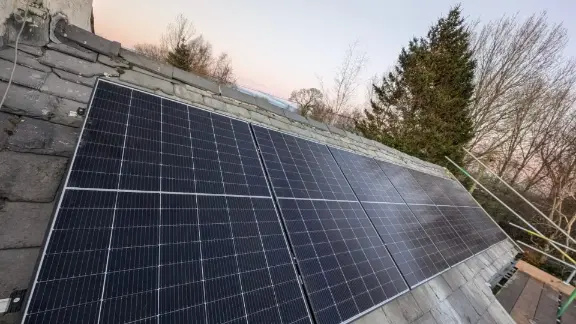
Pair that with a solar panel and battery storage system, and you can charge your car from your own generated electricity. The economics of that combination — solar, battery, and home EV charger — are increasingly compelling for homeowners who are thinking about the bigger picture of their energy use.
Wise Energy Solutions installs all three, which means your solar, battery, and EV charging systems can be designed to work together intelligently rather than as separate, disconnected additions.
The OZEV Grant
The Electric Vehicle Homecharge Scheme has evolved over recent years. Currently, the main grant available is for people in flats or rental accommodation — the EV Chargepoint Grant covers up to 75% of the cost (capped at £350) for eligible renters and flat owners.
For homeowners with off-street parking, grants are no longer available, though the cost of a home charger and installation has come down considerably and remains very reasonable compared to the long-term savings on fuel.
Business and workplace grants exist separately, so if you use your vehicle for work, it’s worth exploring those.
Choosing the Right Charger
There are a lot of brands on the market, and not all are equal. Key things to look for:
Reliability — You want something that works every time, not something that needs rebooting or loses its Wi-Fi connection.
Smart functionality — Scheduling, app control, and compatibility with different tariffs.
Cable tethered vs. socketed — Tethered chargers have the cable permanently attached (convenient, but you’re stuck with one cable type). Socketed chargers let you use different cables, which is useful if you plan to change vehicles.
Future-proofing — Some chargers support vehicle-to-grid (V2G) technology, meaning your car battery could eventually be used as home storage. This is still emerging but worth considering.
Wise Energy Solutions works with proven, reliable charger brands and will recommend the right option for your vehicle and your home setup — not just whatever happens to be in stock.
A Practical Change That Makes a Real Difference
The shift from filling up at a petrol station to plugging in at home sounds small, but for most EV drivers it’s one of the things they appreciate most. You’re never starting the day with less than a full charge (unless you forgot to plug in, which happens), and you’re never waiting at a public charger when you’d rather be somewhere else.
If you’ve recently made the switch to an electric vehicle or you’re thinking about it, getting a home charger installed is one of the most practical things you can do. Speak to the team at Wise Energy Solutions to find out what’s involved for your property.