
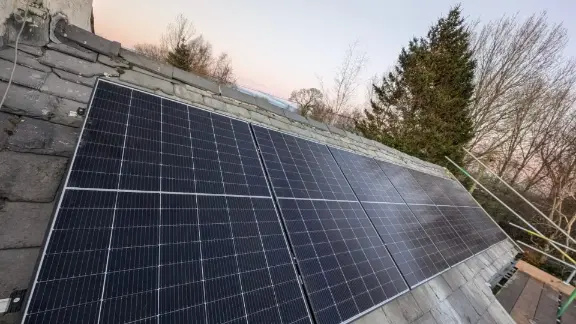
Most people install solar panels and a home battery to cut their electricity bills. That’s a perfectly good reason, and for the majority of households across Blackpool, Preston, and Burnley, the savings on their energy bills are the main payoff.
But there’s a quieter story developing alongside all of that. Home batteries are starting to have value beyond just your own four walls — and some homeowners are already being paid for it.
Here’s what’s actually going on, in plain English.
The Grid Has a Problem Your Battery Can Help Solve
The national electricity grid has to balance supply and demand in real time, constantly. Too much electricity flowing at once and it causes problems. Too little, and prices spike — or in extreme cases, supply struggles to keep up.
This balancing act used to be handled entirely by large power stations. Now, with more renewable energy on the grid and more home batteries being installed, energy companies have started looking at a different approach: pooling thousands of home batteries together and using them collectively to help balance supply and demand.
From the grid’s perspective, ten thousand home batteries all doing the same thing at the same time look a lot like a single large power station. They can soak up surplus electricity when there’s too much being generated, and release stored power during peak demand periods in the evening.
This is what’s called a Virtual Power Plant, or VPP. It sounds technical, but the practical effect for you as a homeowner is fairly simple: you allow an energy company some limited control over when your battery charges and discharges, and in return they pay you for that flexibility.
Your own energy needs are protected within agreed limits — the idea is that your battery serves you first, and the grid second.
What About Selling Your Solar Electricity to Your Neighbours?
You may have heard the phrase “peer-to-peer energy trading” — the idea that instead of selling your surplus solar electricity back to the grid at a modest rate, you could sell it directly to another household at a better price for both of you.
The concept is real and the technology exists. In practice, it’s not yet straightforward for most UK homeowners. The regulations around who can sell electricity to whom are still catching up with the technology, and the platforms that offer genuine peer-to-peer trading are limited in number and not available everywhere.
For a homeowner in Lancashire today, this isn’t something to bank on. It’s worth knowing about, and the direction of travel suggests it’ll become more accessible over the next few years — but it’s not a reason to make decisions about solar and battery storage either way right now.
The Most Useful Thing You Can Do Today: Smart Tariffs
Forget the more complicated stuff for a moment. The single most effective way most homeowners are extracting extra value from a home battery right now is through time-of-use electricity tariffs.
Tariffs like Octopus Go offer genuinely cheap electricity overnight — sometimes as low as 7p per unit — while daytime rates sit at 25–30p or more. A battery system set up to charge from the grid at 7p overnight and then power your home in the evening at 28p is capturing a saving of over 20p on every unit it cycles through.
Over a year, across a 10kWh battery cycling regularly, that’s a meaningful sum on top of whatever you’re already saving through solar self-consumption. It’s not glamorous, but it works today, it’s available to anyone with a compatible battery and a smart meter, and it doesn’t require joining any particular programme.
Does the Battery You Choose Matter?
Yes, more than many people realise.
Some battery systems are relatively closed — they work with their own app and their own programmes, and that’s largely it. Others are designed to be more open, allowing third-party platforms and energy companies to optimise how the battery behaves in response to tariffs, grid signals, or flexibility events.
If you’re interested in making the most of smart tariffs and any future grid flexibility payments, it’s worth discussing this with your installer before you choose a product. The right battery for simple self-consumption isn’t necessarily the right battery if you want to participate in the schemes that are developing.
At Wise Energy Solutions, this is something we factor into our recommendations for homeowners across Blackpool, Fylde Coast, Preston, South Ribble, Burnley, and Pendle. The battery you install now should still be capable of doing useful things five years from now — including things that don’t quite exist yet.
The Simple Version
- Home batteries can do more than just store your solar electricity.
- Energy companies will pay you to let them use your battery’s flexibility to help balance the grid — and this is already happening.
- The most straightforward opportunity today is pairing your battery with a cheap overnight electricity tariff, which can save several hundred pounds a year on top of your solar savings.
- The battery you choose matters — some are better suited to these opportunities than others.
- True peer-to-peer energy trading is coming, but it’s not yet ready for most Lancashire homeowners to act on.
If any of this sounds like something you’d like to understand better for your own home, the team at Wise Energy Solutions is happy to talk it through. No jargon, no pressure — just a straightforward conversation about what’s actually worth doing.
Call 01253 804151 or visit wiseenergy.co.uk