
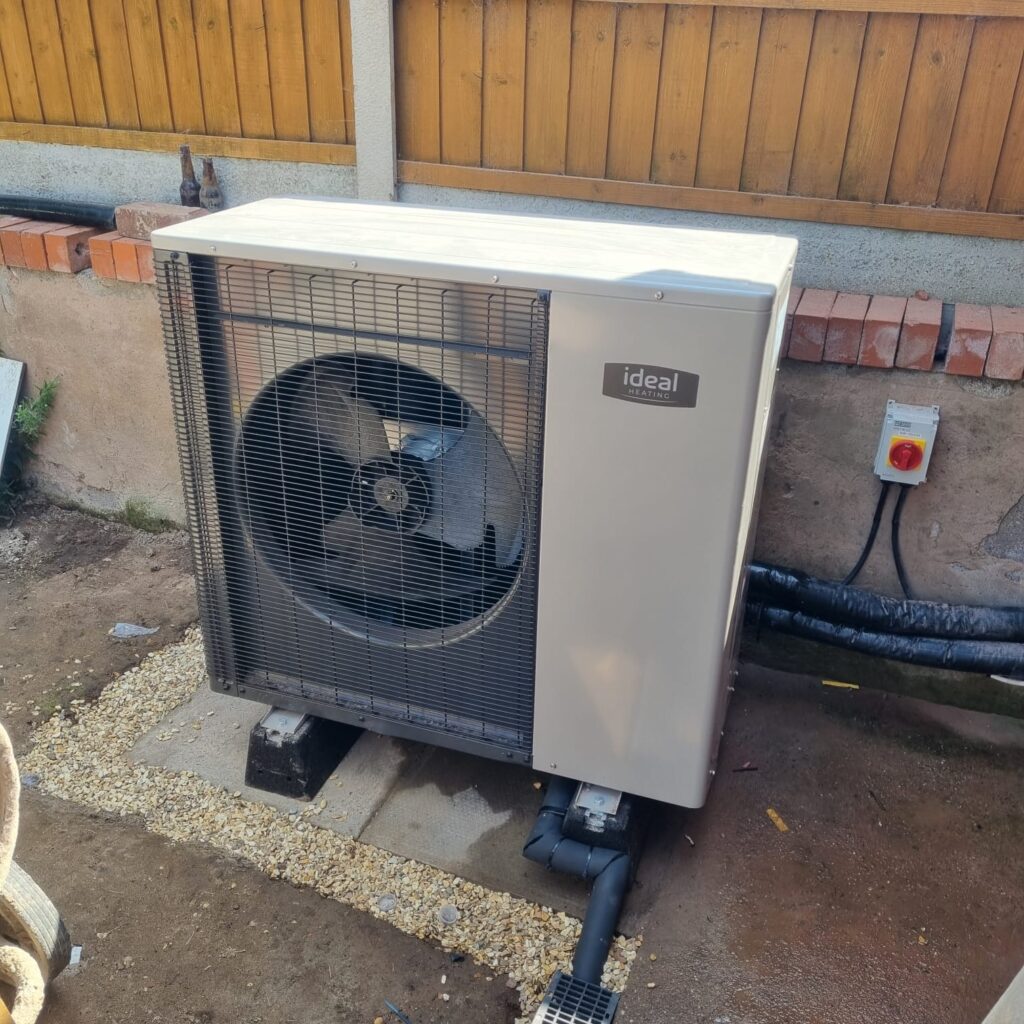
The noise question comes up in almost every conversation about air source heat pumps. It’s a reasonable concern — nobody wants a new appliance humming away outside their home, or worse, disturbing their neighbours. The good news is that modern heat pumps are considerably quieter than most people expect, and there are clear rules governing where they can be sited.
How loud is an air source heat pump, really?
A typical air source heat pump produces around 40 to 50 decibels of noise at one metre distance during operation. To put that in context, normal conversation is about 60dB, and a quiet library is around 40dB. The fan noise from a heat pump is a low, steady hum rather than anything sharp or intermittent.
At three or four metres — which is roughly the distance to a fence or neighbour’s property in many Lancashire terraced or semi-detached homes — the sound level drops further. Most people describe it as similar to the noise from an air conditioning unit, or a quiet fan heater.
That said, ‘how loud’ is only part of the picture. Where the unit is sited matters just as much as the absolute noise level.
Siting and the permitted development rules
In England, air source heat pumps are generally covered by permitted development rights, meaning you don’t need planning permission as long as certain conditions are met. The key ones relevant to noise are:
• The unit must be at least one metre from the property boundary.
• Only one heat pump is permitted per property under permitted development.
• The unit must be sited to minimise the effect on neighbours — which includes considering noise.
• It must meet the Microgeneration Certification Scheme (MCS) planning standard for noise, known as MCS 020.
MCS 020 sets out a methodology for assessing whether a heat pump installation will cause undue noise impact. It takes into account the background noise level at the site, the distance to neighbouring properties, and any features that might reflect or amplify sound. A competent installer will carry out this assessment as part of the design process.
What MCS 020 actually means in practice
The standard requires that the heat pump adds no more than a certain amount to the existing background noise level at the nearest noise-sensitive location (typically a neighbouring window or door). The threshold is usually a 5dB increase over background — which is roughly the point at which most people start to notice a change in sound environment.
In practice, most modern heat pumps comfortably meet this standard when sited thoughtfully. The main variables are proximity to boundaries and neighbouring windows, and whether there are hard surfaces (walls, fences) that might reflect sound back towards the neighbour.
If your garden is tight, or you have close neighbours on both sides — which is common in many parts of Burnley, Blackpool, and Preston — your installer should model the noise impact before confirming the installation position. It’s not complicated, but it does need to be done.
Can noise be reduced further?
Yes, in several ways. Position is the biggest lever — siting the unit at the end of the garden, or in a corner where walls will absorb rather than reflect sound, makes a meaningful difference. Keeping the unit away from bedroom windows (both yours and your neighbours’) is good practice.
Acoustic fencing or purpose-built baffles can also help if the site is constrained. These aren’t always necessary, but they’re a practical option when the geometry of a plot is challenging.
Newer heat pump models have also got progressively quieter. Units from established manufacturers operating at low to medium output can run as quietly as 38 or 39dB — genuinely unobtrusive levels for most residential settings.
What about overnight operation?
Heat pumps run most efficiently when they run steadily at lower output rather than cycling on and off. In practice, this means they may run overnight — particularly in winter when the heating system is maintaining a set temperature.
This is worth thinking about when considering siting. A unit positioned directly beneath a bedroom window — yours or next door’s — is more likely to be noticeable overnight than one sited at the side or rear of the property away from sleeping areas. A good installer will factor this into the placement recommendation.
Do you need to tell your neighbours?
There’s no legal requirement to consult neighbours before installing a heat pump under permitted development, but it’s worth considering. If you have close neighbours in a semi-detached or terrace, a quick conversation before installation — explaining what a heat pump is, what it sounds like, and where it’s going — tends to prevent misunderstandings afterwards.
Most neighbours, once they understand what they’re hearing, have no issue with it. Problems tend to arise when the noise is unexpected and the neighbour doesn’t know what’s causing it.
Wise Energy Solutions surveys every site before installation and carries out the MCS 020 noise assessment as standard. If a site has constraints, we’ll identify them upfront and recommend the best position — not just the most convenient one. We work across Blackpool, Preston, and Burnley, and we know the kind of plot layouts that need careful thought.
📞 Want to know if a heat pump is suitable for your plot? Call 01253804151 or visit wiseenergy.co.uk.