
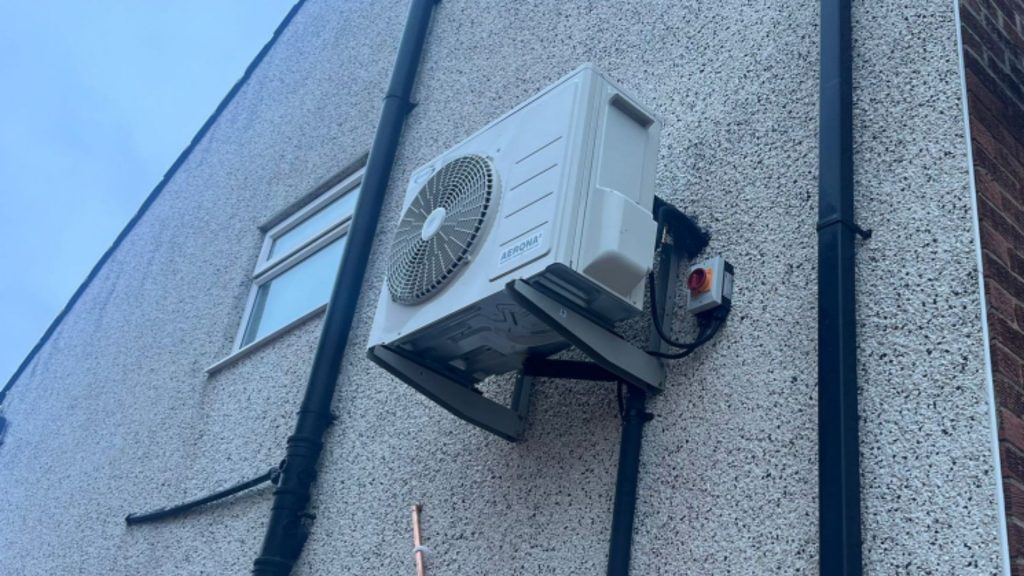
There’s a persistent idea floating around that you can only get the best out of an air source heat pump if you rip up your floors and install underfloor heating. It’s understandable where this comes from — underfloor heating and heat pumps are genuinely a good pairing. But it’s also one of those half-truths that puts people off making a switch that could genuinely work well for them.
The reality is more straightforward, and more encouraging, than that.
Why underfloor heating and heat pumps are often mentioned together
Heat pumps work at lower flow temperatures than a gas boiler. A conventional boiler might heat water to 70°C or 80°C before sending it around your radiators. An air source heat pump typically operates at around 35°C to 50°C — efficiently, and by design.
Underfloor heating is perfectly suited to these lower temperatures. It uses a large surface area (your entire floor) to distribute heat, which means it doesn’t need especially hot water to warm a room to a comfortable temperature. The two technologies complement each other naturally.
That’s where the idea comes from. But it’s only half the picture.
What actually happens with radiators
Standard radiators are designed to work with the higher flow temperatures of a gas boiler. When a heat pump runs at lower temperatures through the same radiators, they don’t produce as much heat per unit of time — which means in colder weather, a room might heat up more slowly, or struggle to reach temperature if the radiators were undersized to begin with.
The solution isn’t necessarily underfloor heating. Often it’s simply larger radiators, or more of them. A properly sized radiator running at 45°C can deliver perfectly comfortable heat — it just needs more surface area than a radiator running at 70°C.
This is why a proper heat pump survey matters so much. A good installer will calculate the heat loss of each room in your home, then size the radiators accordingly. Homes in Burnley or Preston that had radiators installed decades ago often have radiators that are over-specified anyway — particularly in living rooms and hallways where builders tended to err on the generous side. In those cases, existing radiators can sometimes be used without any changes at all.
How do you know if your radiators need upgrading?
Your installer will carry out a heat loss calculation — sometimes called a room-by-room survey — as part of the design process for your heat pump system. This calculates how much heat each room needs to stay warm at design conditions (typically -3°C outside for most of Lancashire), then compares that against what your existing radiators can deliver at heat pump flow temperatures.
Where there’s a shortfall, you have options: replace individual radiators with larger ones, add additional radiators, or convert specific rooms to underfloor heating where it makes practical sense (a new kitchen extension, for example, or a bathroom refit).
In practice, most homes need some radiator upgrades — perhaps two or three across the whole house — rather than a complete overhaul. It’s rarely as disruptive or expensive as people assume.
Where underfloor heating genuinely does make more sense
If you’re building an extension, having a major renovation, or fitting new floor coverings anyway, underfloor heating is absolutely worth specifying. The incremental cost when it’s going in during a build or refurb is modest, and you’ll get the benefit for decades.
Ground floor rooms in newer builds or well-insulated homes are also strong candidates. A well-insulated room with low heat loss will perform excellently with underfloor heating at heat pump flow temperatures.
Upper floors are different. Retrofitting underfloor heating upstairs typically means lifting floorboards throughout, which is a major job. Most homeowners in Lancashire opt for upgraded radiators upstairs and reserve underfloor heating for ground floor rooms where it’s being newly installed.
Mixing systems is perfectly normal
A heat pump doesn’t need a single consistent heat emitter throughout the house. Many installations use underfloor heating downstairs and radiators upstairs — or a combination that reflects where renovations have already happened.
Modern heat pump controllers manage flow temperatures to suit whichever emitters are installed. The system is designed with this in mind.
The honest answer
Underfloor heating is great with a heat pump, but it’s not a prerequisite. A properly designed system with appropriately sized radiators will perform well, keep your home comfortable, and run efficiently. The key word is ‘properly designed’ — which is why a thorough survey is essential before any heat pump installation.
Wise Energy Solutions covers Blackpool and the Fylde Coast, Preston and South Ribble, and Burnley and Pendle. We carry out full room-by-room heat loss calculations before recommending any system, and we’ll give you an honest picture of what your home needs — not a one-size-fits-all proposal.
Want to know what your home actually needs? Call 01253804151 or visit wiseenergy.co.uk for a free assessment.