
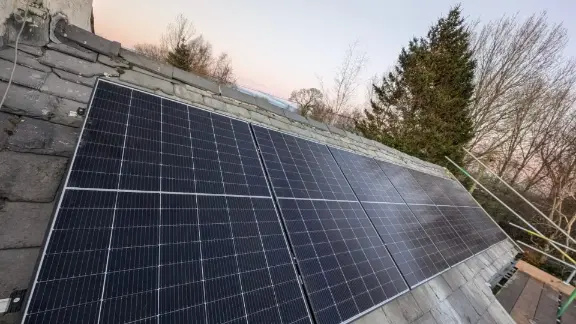
If you’ve been looking into solar for your home in Preston, Burnley, or across the Fylde Coast, you’ve probably come across the question of whether to add battery storage at the same time. It’s a common point of uncertainty — solar panels on their own are one thing, but add a battery to the mix and both the cost and the benefits change considerably.
Here’s an honest look at how the combination works and whether it makes sense.
The Problem Solar Alone Doesn’t Solve
Solar panels generate electricity when the sun is up (or more accurately, when there’s sufficient daylight). The issue is that your household’s peak demand rarely aligns with peak generation.
During a summer weekday, your panels might be generating strongly between 9am and 4pm. But if you’re at work, the house is largely empty, and most of that electricity flows back to the grid. You get paid for it through the Smart Export Guarantee, but typically at a fairly modest rate — far less than you’d save by actually using the electricity yourself.
Come evening, you’re home, cooking, showering, watching the telly — and your panels have stopped generating. So you’re buying electricity from the grid at full price.
This mismatch is the fundamental limitation of solar without storage.
What a Battery Changes
A home battery — systems like the GivEnergy, SolarEdge, or similar units Wise Energy Solutions works with — stores the excess electricity your panels generate during the day. Instead of going back to the grid, it sits in the battery waiting for you to need it.
In practical terms, it means your evening electricity use is powered by what your panels generated in the afternoon, rather than what you’re pulling from the grid. For most households, this meaningfully increases what’s called “self-consumption” — the proportion of your solar generation you actually use yourself.
Higher self-consumption means more of your solar investment pays off directly, because every unit you use from your battery is a unit you’d otherwise buy from your supplier.
The Numbers
Battery storage adds cost to the overall installation — typically somewhere in the range of £3,000 to £6,000 depending on the capacity and brand, though prices vary. That’s a meaningful addition to a solar install.
Whether it pays back in a reasonable timeframe depends on a few factors: how much electricity you use and when, your export tariff, and your import tariff. For a household with high evening usage and a moderate solar array, the maths often stacks up well. For a retired couple who are home during the day and naturally self-consuming a lot of their solar generation, the additional benefit of a battery is smaller.
This is why a proper conversation about your actual usage patterns matters more than a generic recommendation. At Wise Energy Solutions, that’s how we approach it — looking at what your household actually does rather than assuming everyone’s the same.
Installing Together vs. Adding a Battery Later
One practical consideration: it’s generally more cost-effective to install solar and battery storage at the same time, rather than adding a battery as a later addition.
When you install together, a single hybrid inverter handles both, the installation is more efficient, and the systems are designed to work together from the outset. Adding a battery later requires either replacing or adding to the inverter setup, which creates additional cost and complexity.
If you’re planning to have battery storage eventually, it’s worth thinking about it from the beginning — even if you don’t pull the trigger on both immediately, choosing a solar inverter that’s battery-ready keeps the option open without a major additional cost.
Beyond the House Battery: EV Charging Integration
For homeowners who also drive an electric vehicle, there’s a further layer to the combination that’s worth understanding. A solar-battery system can be set up to intelligently manage charging your car, prioritising your own generated electricity and cheap off-peak grid electricity over expensive peak-rate power.
The integration between solar panels, battery storage, and EV charging is becoming increasingly sophisticated. Managed well, it can dramatically reduce what you spend on electricity overall — covering your household needs, your hot water (if you’ve also got a heat pump), and your car from a combination of solar generation and cheap overnight grid electricity.
Wise Energy Solutions installs all three technologies, which means this kind of integrated setup is something we can plan and deliver as a coherent system rather than a collection of bits bolted together.
The Verdict
For most homeowners across the Fylde Coast, Preston, and Burnley, the combination of solar and battery storage makes more sense than solar alone — particularly if you have an EV, if your household energy use is weighted towards evenings, or if you’re thinking about adding a heat pump in the future.
It’s a bigger upfront investment, but it’s also a more complete solution. And with energy prices unlikely to fall significantly over the long term, locking in a greater proportion of your electricity needs from your own generation is a sensible position to take.
Want to know what the numbers would look like for your specific home? Get in touch with Wise Energy Solutions and we’ll work through it with you.